
FinOps does not begin with cost reduction.
The true starting point of FinOps is the ability to explain how cloud spending translates into real business outcomes.
The same KRW 100 million in cloud costs can mean very different things:
The challenge is that the business data required to make this judgment usually remains inside the company.
Uploading sensitive metrics such as revenue, order volume, or active user counts to external SaaS platforms still presents significant security concerns.
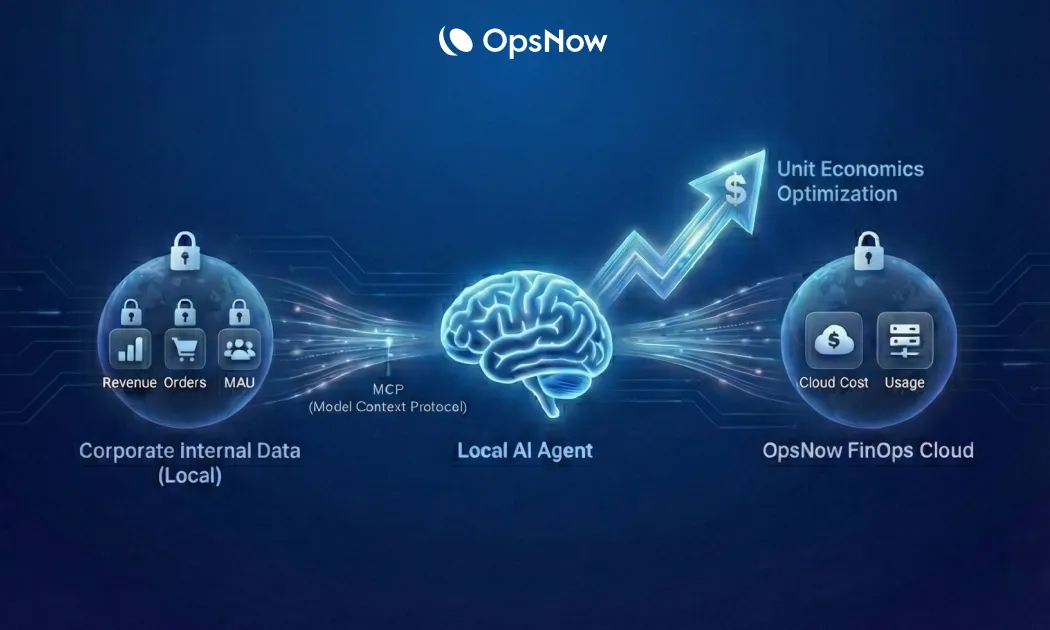
This is where OpsNow MCP (Model Context Protocol) introduces a fundamentally different approach.
Instead of moving data, AI connects only the necessary context.
“Keep sensitive data inside. Let AI deliver the insights.”
Organizations with hands-on FinOps experience tend to share the same challenge:
“We can see the cloud costs, but it’s hard to explain whether they are good or bad from a business perspective.”
The reason is clear.
Cloud cost data lives in FinOps tools like OpsNow, while business KPIs are scattered across internal databases, accounting systems, and marketing reports.
With OpsNow MCP, this structure changes:
In other words, the data never moves — only the context does.
Three Practical Unit Economics Use Cases
The FinOps Foundation recommends continuously monitoring unit costs, not just total spend.
Below are three representative scenarios that can be realistically implemented using OpsNow MCP.
Scenario
An e-commerce company runs a large-scale promotional campaign.
Overall cloud costs increase, but the real question is whether efficiency per order improved.
Where the data lives
Example AI request
“Combine order_report.csv with OpsNow cost data and analyze how cloud cost per order changed compared to last month.”
Insight
Order volume increased by 50%, while infrastructure costs increased by only 20%.
Cost per order decreased from $0.15 to $0.12, representing a 20% efficiency improvement.
→ The cost increase can be interpreted as a reasonable investment tied to business performance.
Scenario
A rapidly growing SaaS startup receives a request from the finance team:
“How much does it cost to maintain a single active user?”
Where the data lives
Example AI request
“Analyze recent trends in cost per MAU and determine whether the cost structure changed after the new feature launch.”
Insight
Usage surged in a specific region, leading to a 15% increase in cost per MAU.
This clearly highlights the need for architectural optimization of the new feature.
→ FinOps moves beyond cost cutting to identifying concrete technical improvement opportunities.
Scenario
An ad-tech company needs to compare campaign-level revenue with infrastructure costs.
Where the data lives
Example AI request
“Compare this month’s ad revenue with cloud costs by campaign and identify accounts with low ROI.”
Insight
→ Cloud cost data is transformed into decision-ready FinOps intelligence.
Why This Architecture Works
The key lies in the direction of data flow:
This enables business-oriented FinOps analysis without compromising security.
“Costs increased — and the business actually improved.”
Teams no longer need to struggle when asked,
“Why did our cloud bill increase this month?”
With OpsNow MCP, they can confidently answer:
“Costs increased, but unit-level efficiency improved by this much.”
Keep your data secure.
Make better decisions with clarity.
Real FinOps starts with OpsNow MCP.
FinOps does not begin with cost reduction.
The true starting point of FinOps is the ability to explain how cloud spending translates into real business outcomes.
The same KRW 100 million in cloud costs can mean very different things:
The challenge is that the business data required to make this judgment usually remains inside the company.
Uploading sensitive metrics such as revenue, order volume, or active user counts to external SaaS platforms still presents significant security concerns.
This is where OpsNow MCP (Model Context Protocol) introduces a fundamentally different approach.
Instead of moving data, AI connects only the necessary context.
“Keep sensitive data inside. Let AI deliver the insights.”
Organizations with hands-on FinOps experience tend to share the same challenge:
“We can see the cloud costs, but it’s hard to explain whether they are good or bad from a business perspective.”
The reason is clear.
Cloud cost data lives in FinOps tools like OpsNow, while business KPIs are scattered across internal databases, accounting systems, and marketing reports.
With OpsNow MCP, this structure changes:
In other words, the data never moves — only the context does.
Three Practical Unit Economics Use Cases
The FinOps Foundation recommends continuously monitoring unit costs, not just total spend.
Below are three representative scenarios that can be realistically implemented using OpsNow MCP.
Scenario
An e-commerce company runs a large-scale promotional campaign.
Overall cloud costs increase, but the real question is whether efficiency per order improved.
Where the data lives
Example AI request
“Combine order_report.csv with OpsNow cost data and analyze how cloud cost per order changed compared to last month.”
Insight
Order volume increased by 50%, while infrastructure costs increased by only 20%.
Cost per order decreased from $0.15 to $0.12, representing a 20% efficiency improvement.
→ The cost increase can be interpreted as a reasonable investment tied to business performance.
Scenario
A rapidly growing SaaS startup receives a request from the finance team:
“How much does it cost to maintain a single active user?”
Where the data lives
Example AI request
“Analyze recent trends in cost per MAU and determine whether the cost structure changed after the new feature launch.”
Insight
Usage surged in a specific region, leading to a 15% increase in cost per MAU.
This clearly highlights the need for architectural optimization of the new feature.
→ FinOps moves beyond cost cutting to identifying concrete technical improvement opportunities.
Scenario
An ad-tech company needs to compare campaign-level revenue with infrastructure costs.
Where the data lives
Example AI request
“Compare this month’s ad revenue with cloud costs by campaign and identify accounts with low ROI.”
Insight
→ Cloud cost data is transformed into decision-ready FinOps intelligence.
Why This Architecture Works
The key lies in the direction of data flow:
This enables business-oriented FinOps analysis without compromising security.
“Costs increased — and the business actually improved.”
Teams no longer need to struggle when asked,
“Why did our cloud bill increase this month?”
With OpsNow MCP, they can confidently answer:
“Costs increased, but unit-level efficiency improved by this much.”
Keep your data secure.
Make better decisions with clarity.
Real FinOps starts with OpsNow MCP.
FinOps does not begin with cost reduction.
The true starting point of FinOps is the ability to explain how cloud spending translates into real business outcomes.
The same KRW 100 million in cloud costs can mean very different things:
The challenge is that the business data required to make this judgment usually remains inside the company.
Uploading sensitive metrics such as revenue, order volume, or active user counts to external SaaS platforms still presents significant security concerns.
This is where OpsNow MCP (Model Context Protocol) introduces a fundamentally different approach.
Instead of moving data, AI connects only the necessary context.
“Keep sensitive data inside. Let AI deliver the insights.”
Organizations with hands-on FinOps experience tend to share the same challenge:
“We can see the cloud costs, but it’s hard to explain whether they are good or bad from a business perspective.”
The reason is clear.
Cloud cost data lives in FinOps tools like OpsNow, while business KPIs are scattered across internal databases, accounting systems, and marketing reports.
With OpsNow MCP, this structure changes:
In other words, the data never moves — only the context does.
Three Practical Unit Economics Use Cases
The FinOps Foundation recommends continuously monitoring unit costs, not just total spend.
Below are three representative scenarios that can be realistically implemented using OpsNow MCP.
Scenario
An e-commerce company runs a large-scale promotional campaign.
Overall cloud costs increase, but the real question is whether efficiency per order improved.
Where the data lives
Example AI request
“Combine order_report.csv with OpsNow cost data and analyze how cloud cost per order changed compared to last month.”
Insight
Order volume increased by 50%, while infrastructure costs increased by only 20%.
Cost per order decreased from $0.15 to $0.12, representing a 20% efficiency improvement.
→ The cost increase can be interpreted as a reasonable investment tied to business performance.
Scenario
A rapidly growing SaaS startup receives a request from the finance team:
“How much does it cost to maintain a single active user?”
Where the data lives
Example AI request
“Analyze recent trends in cost per MAU and determine whether the cost structure changed after the new feature launch.”
Insight
Usage surged in a specific region, leading to a 15% increase in cost per MAU.
This clearly highlights the need for architectural optimization of the new feature.
→ FinOps moves beyond cost cutting to identifying concrete technical improvement opportunities.
Scenario
An ad-tech company needs to compare campaign-level revenue with infrastructure costs.
Where the data lives
Example AI request
“Compare this month’s ad revenue with cloud costs by campaign and identify accounts with low ROI.”
Insight
→ Cloud cost data is transformed into decision-ready FinOps intelligence.
Why This Architecture Works
The key lies in the direction of data flow:
This enables business-oriented FinOps analysis without compromising security.
“Costs increased — and the business actually improved.”
Teams no longer need to struggle when asked,
“Why did our cloud bill increase this month?”
With OpsNow MCP, they can confidently answer:
“Costs increased, but unit-level efficiency improved by this much.”
Keep your data secure.
Make better decisions with clarity.
Real FinOps starts with OpsNow MCP.